


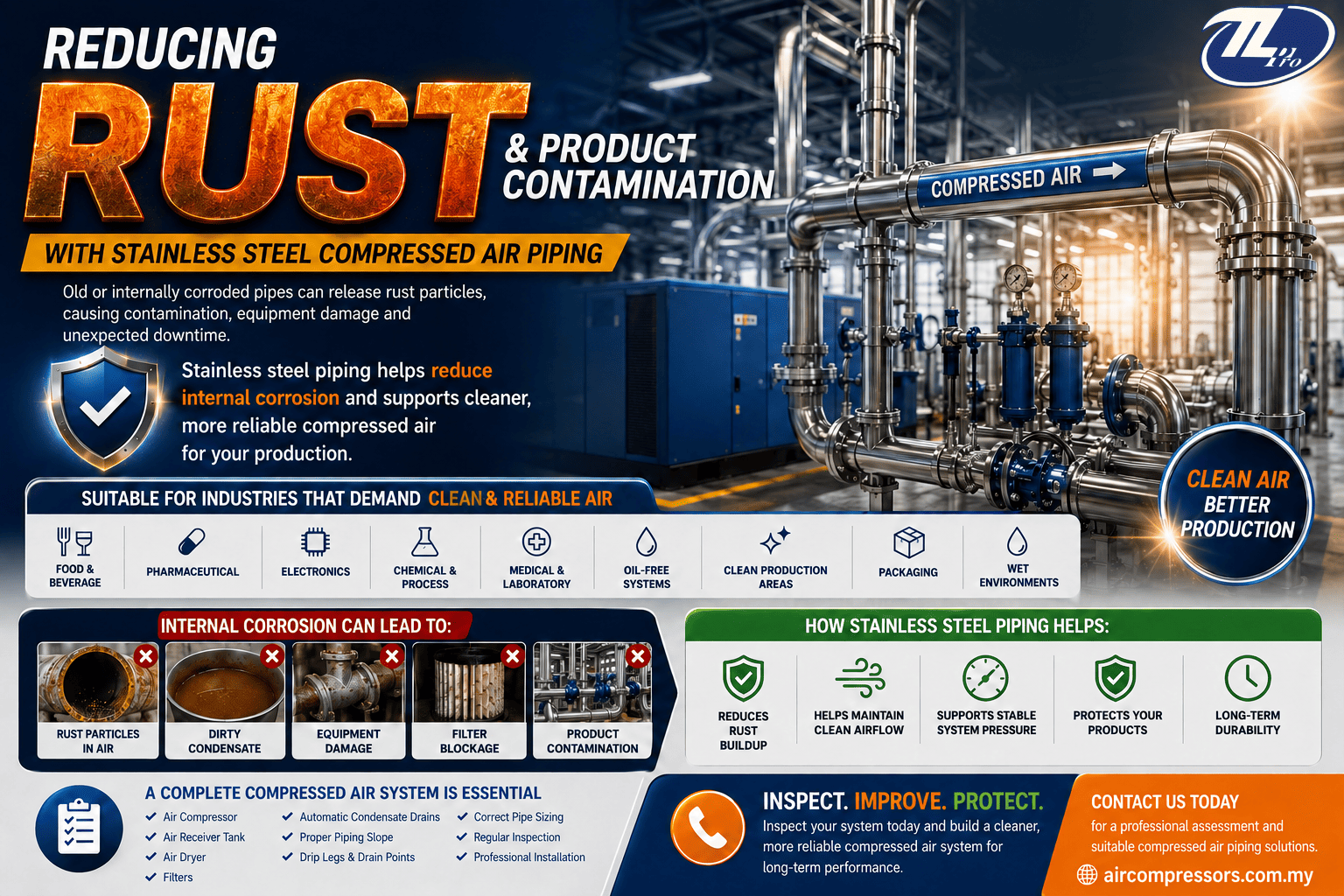
Do you notice rust particles, dirty condensate or contamination at your compressed air points of use?
The problem may not come from the air compressor alone.
Even after installing an air dryer and filters, treated compressed air must still travel through the receiver tank and piping network before reaching production machines.
If the existing piping is old or internally corroded, rust and pipe scale may enter the compressed air again.
For factories that require clean and reliable air, stainless steel compressed air piping can help reduce corrosion and protect sensitive production processes.
However, the most suitable piping material depends on the required air quality, operating environment, installation conditions, maintenance expectations and project budget.
How Compressed Air Piping Becomes Contaminated
Compressed air naturally contains moisture.
As the compressed air cools, water vapour may turn into liquid condensate. If the dryer, filters or automatic drains are not working correctly, moisture may remain inside the piping system.
Over time, trapped moisture may cause internal corrosion in ageing, poorly maintained or unsuitable piping systems.
Rust and pipe scale may eventually break away and travel downstream with the compressed air.
This means clean air leaving the air treatment equipment may become contaminated again before reaching the point of use.
Common Signs of Rust Inside Compressed Air Piping
Internal pipe corrosion is often hidden from view.
However, your system may show several warning signs:
- Brown or dirty water at drain points
- Rust particles inside filters
- Dirty air at production machines
- Frequent blockage of valves and small air passages
- Recurring pipe leakage
- Contamination marks on products or packaging
- Unstable pneumatic equipment operation
- Repeated failure of cylinders, valves or air tools
These signs should not be ignored.
Replacing the air compressor may not solve the problem if the old piping network remains corroded or contaminated.
How Rust and Pipe Scale Affect Production
Rust inside compressed air piping can create more than a maintenance issue.
It may affect the quality, reliability and efficiency of your production process.
Possible problems include:
- Product contamination
- Packaging contamination
- Damage to pneumatic components
- Blocked filters and valves
- Unstable machine performance
- Increased maintenance costs
- More frequent filter replacement
- Unexpected production downtime
- Shorter equipment lifespan
The risk is more serious when compressed air comes into direct or indirect contact with products, ingredients or packaging.
How Stainless Steel Compressed Air Piping Helps
Stainless steel offers strong corrosion resistance and long-term durability.
Its smooth internal surface also helps maintain cleaner airflow throughout the compressed air network.
Reduces Internal Corrosion
Stainless steel provides strong resistance to internal corrosion when the correct grade, fittings and installation method are used.
This helps reduce the risk of rust particles entering downstream filters, valves and production equipment.
Maintains Cleaner Air Distribution
Air dryers and filters remove moisture, oil and particles from compressed air.
Stainless steel piping helps maintain the treated air quality while the air travels from the compressor room to production.
This is especially important for applications where cleanliness affects product quality.
Provides a Smooth Internal Surface
A smooth pipe surface reduces areas where dirt, rust and pipe scale can accumulate.
Its smooth internal surface can help reduce contamination buildup and support efficient airflow when the piping is correctly sized and installed.
Supports Stable Air Pressure
Internal corrosion and buildup can restrict airflow and increase pressure drop.
Correctly sized stainless steel compressed air piping helps maintain more stable pressure at production machines.
However, the pipe diameter and system layout must be designed according to the required airflow.
Offers Long-Term Durability
When the correct stainless steel grade, fittings and installation method are used, the piping can provide reliable long-term performance.
This may help reduce maintenance associated with internal corrosion, ageing pipework and deteriorated joints.
Choosing the Right Compressed Air Piping Material
Stainless steel piping is not required for every compressed air installation.
The most suitable piping material depends on several factors, including air-quality requirements, operating environment, system pressure, installation conditions, maintenance expectations and project budget.
Stainless steel is commonly selected where corrosion resistance, cleanliness and long-term durability are priorities. Other materials, such as GI or Aluminium piping, may also be suitable for different industrial applications when correctly designed, installed and maintained.
A professional system assessment can help determine the most practical piping material for the factory’s operating requirements and long-term plans.
Industries That May Require Stainless Steel Piping
Stainless steel compressed air piping is suitable for factories where air cleanliness, corrosion resistance and process reliability are important.
Common applications include:
- Food and beverage processing
- Pharmaceutical manufacturing
- Electronics production
- Medical and laboratory facilities
- Chemical and process plants
- Packaging operations
- Clean production areas
- Oil-free compressed air systems
- Wet or frequently washed production areas
The correct piping grade should be selected according to the application, environment and required air-quality level.
Stainless Steel Piping Alone Is Not Enough
Installing stainless steel piping does not automatically produce clean and dry compressed air.
A complete compressed air system may still require:
- Correctly sized air compressor
- Air receiver tank
- Water separator
- Refrigerated or desiccant air dryer
- Coalescing and particulate filters
- Reliable automatic condensate drains
- Correct piping slope
- Proper drip legs and drain points
- Regular inspection and maintenance
All components must work together to control moisture, oil, particles and pressure loss.
If the dryer, filters or condensate drains are not working properly, contamination problems may continue even after installing new piping.
Important Checks Before Installing Stainless Steel Piping
A professional system assessment should be carried out before installation.
Pipe Size
The piping must support the required airflow without causing excessive pressure drop.
Future production expansion should also be considered.
System Layout
A properly designed ring main can improve air distribution and pressure stability.
Branch lines, drop legs, isolation valves and drain points should be positioned correctly.
Stainless Steel Grade
The correct stainless steel grade must suit the application, environment and cleanliness requirements.
Operating Pressure
The pipes, valves, fittings and joints must be suitable for the system’s maximum operating pressure.
Installation Quality
Poor welding, incorrect fittings or inadequate pipe supports may cause leakage and maintenance problems.
Installation should be carried out by experienced personnel.
Existing Piping Condition
Before connecting new stainless steel piping to an existing network, the old piping should be inspected for rust, dirt and contamination.
Connecting clean new pipes to a heavily contaminated system may reduce the expected improvement.
When Should Your Existing Piping Be Inspected?
Arrange a piping inspection if you notice:
- Rust particles at the point of use
- Brown or dirty condensate
- Frequent filter blockage
- Recurring pipe leakage
- Unstable pressure at production machines
- High pressure in the compressor room but low pressure at the machines
- Repeated pneumatic equipment failure
- Product or packaging contamination
- An old piping network connected to a new compressor or dryer
A complete inspection can determine whether the problem comes from internal corrosion, poor drainage, air leakage, incorrect pipe size or insufficient air treatment.
Build a Cleaner and More Reliable Compressed Air System
Rust inside compressed air piping should not be ignored.
It can affect compressed air quality, damage production equipment and increase operating costs.
Stainless steel compressed air piping can help reduce internal corrosion and protect sensitive production processes.
However, the best results come from combining the correct piping material with proper sizing, drainage, filtration and professional installation.
The correct solution should be selected according to the factory’s air-quality requirements, operating environment, production needs and available budget.
If your factory is experiencing rusty condensate, recurring leakage, product contamination or unstable air pressure, inspect the complete compressed air system before the problem becomes more serious.
Need Assistance?
TL PRO Industrial Supplies Sdn. Bhd. provides professional compressed air piping installation, modification and troubleshooting services in Malaysia.
We can inspect your existing system and recommend a practical solution based on your airflow, operating pressure, production requirements and site conditions.
Whether your application requires Stainless Steel, GI or Aluminium piping, proper system design and installation are essential for reliable compressed air distribution.
Contact TL PRO today for assistance with your industrial compressed air piping system.