


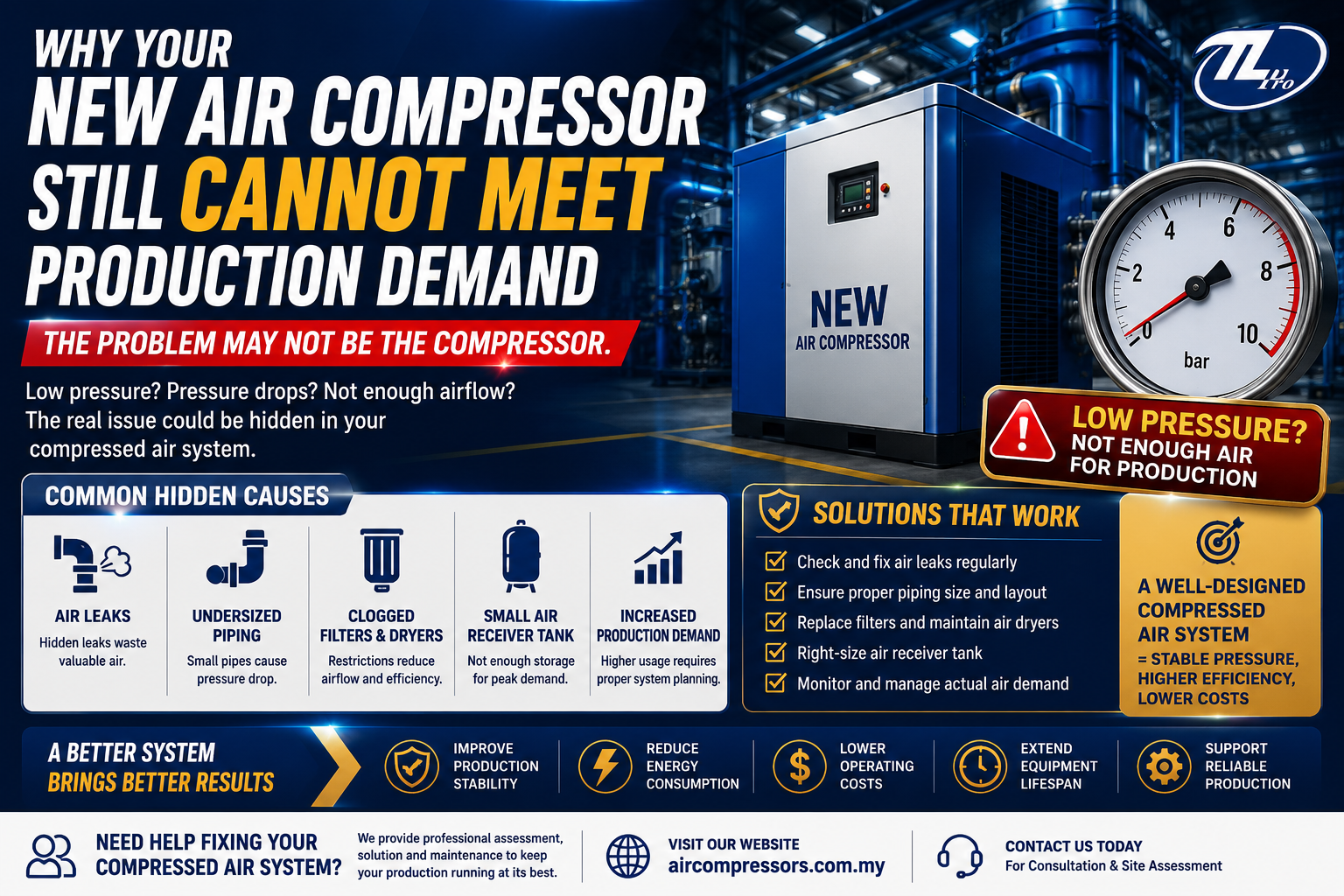
Many factory owners assume that installing a new air compressor will solve all compressed air problems.
However, it is common to hear:
- “We just installed a new compressor, but the pressure is still low.”
- “Production is increasing, but the air supply is not enough.”
- “The compressor is running all the time.”
- “Some machines still experience pressure drops.”
If you are facing these issues, the compressor itself may not be the real problem.
Let’s look at some common reasons why a new air compressor still cannot meet production demand.
1. The Air Compressor Is Not Properly Sized
One of the most common problems is selecting a compressor based only on horsepower.
A larger motor does not always mean a larger air supply.
The important factor is the actual airflow requirement of your production equipment.
If the compressor capacity is lower than the total air demand, pressure problems will continue even with a new machine.
Signs of an undersized compressor:
- Pressure drops during peak production
- Compressor runs continuously
- Frequent loading and unloading
- Production equipment receives insufficient air
2. Compressed Air Leaks Are Wasting Capacity
Air leaks are often hidden and difficult to detect.
Even a small leak can waste a significant amount of compressed air over time.
In some factories, air leaks can account for 20% to 30% of total compressed air consumption.
As a result, the new compressor works harder while production still experiences low pressure.
Common leak locations:
- Pipe joints
- Flexible hoses
- Quick couplings
- Drain valves
- Air receivers
Regular leak inspections can help recover lost capacity without investing in larger equipment.
3. Compressed Air Piping Is Too Small
Many factories upgrade the compressor but continue using old piping.
If the pipe diameter is too small, airflow becomes restricted.
This creates pressure drops between the compressor room and production area.
As a result, the compressor may show normal pressure while machines receive insufficient air.
Common signs:
- Good pressure near the compressor
- Low pressure at production machines
- Pressure drops during high demand periods
Proper piping design is essential for efficient airflow.
4. Air Filters and Dryers Are Causing Pressure Loss
Compressed air passes through filters and air dryers before reaching production equipment.
Over time, filter elements become clogged and create airflow restrictions.
This increases pressure loss throughout the system.
Warning signs include:
- High differential pressure across filters
- Reduced airflow
- Increased energy consumption
- Frequent compressor operation
Routine maintenance helps maintain system performance.
5. The Air Receiver Tank Is Too Small
An air receiver tank stores compressed air and helps stabilize pressure.
If the tank is undersized, sudden production demand can cause pressure fluctuations.
This is especially common in factories where multiple machines start operating simultaneously.
A properly sized air receiver can improve system stability and reduce compressor workload.
6. Production Demand Has Increased
Many factories expand production over time.
Additional machinery often increases compressed air consumption beyond the original system design.
Although the compressor is new, the total air demand may now exceed system capacity.
A compressed air audit can help determine whether the existing system is still suitable.
How to Solve the Problem
If your new air compressor still cannot meet production demand, consider checking:
✅ Compressor sizing
✅ Air leakage
✅ Piping design
✅ Filter condition
✅ Air dryer performance
✅ Air receiver tank capacity
✅ Actual air consumption
A complete system evaluation often identifies the real cause of the problem.
Conclusion
A new air compressor does not always guarantee better production performance.
In many cases, the problem lies elsewhere within the compressed air system.
By identifying issues such as air leaks, pressure drops, piping restrictions, or insufficient storage capacity, factories can improve efficiency and achieve a more reliable compressed air supply.
If your factory is experiencing low pressure, insufficient airflow, or compressed air system performance issues, professional system assessment can help identify the root cause and recommend the most cost-effective solution.