


Have you ever wondered how factories keep machines cool even when production runs all day?
The answer is often a chilled water chiller system.
Many manufacturing plants rely on chilled water systems to remove heat from machinery and production processes. Without proper cooling, equipment can overheat, production may slow down, and operating costs can increase.
In this guide, we’ll explain what a chilled water chiller system is, how it works, its main components, common applications, and why regular maintenance is important.
What Is a Chilled Water Chiller System?
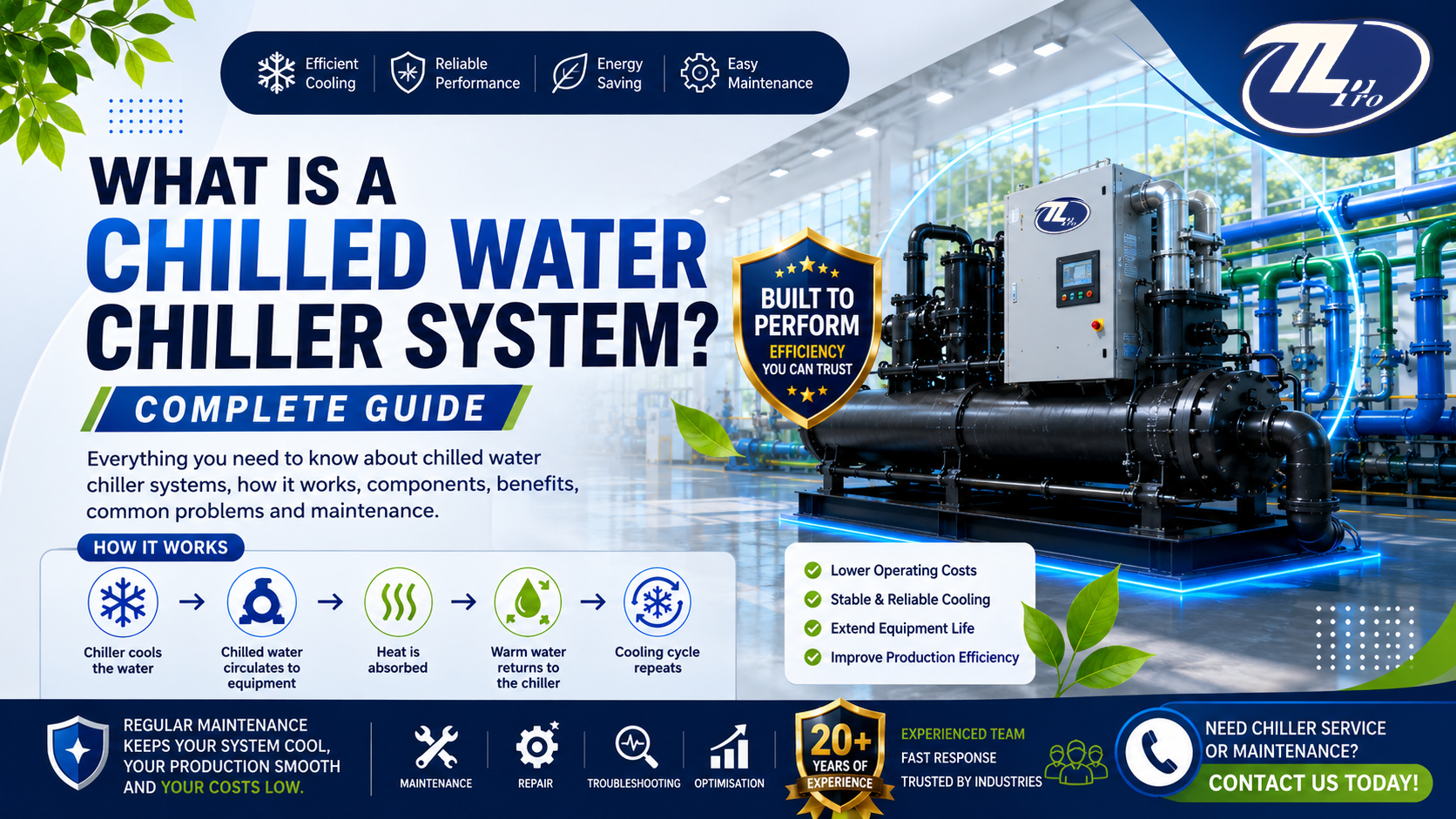
A chilled water chiller system is an industrial cooling system that removes heat from water before circulating it through equipment or buildings.
Instead of blowing cold air directly, the chiller cools water first. The chilled water then absorbs heat from machines before returning to the chiller to be cooled again.
This continuous cycle provides reliable and energy-efficient cooling.
Why Is a Chilled Water Chiller System Important?
Without proper cooling, factories may experience:
✅ Machine overheating
✅ Unexpected production downtime
✅ Higher electricity consumption
✅ Poor product quality
✅ Shorter equipment lifespan
A properly maintained chiller helps keep production running smoothly while reducing operating costs.
How Does a Chilled Water Chiller System Work?
Although the system may look complicated, the operating principle is quite simple.
Step 1 – The Chiller Cools the Water
Inside the chiller, refrigerant removes heat from the circulating water.
As a result, the water temperature is reduced before it leaves the chiller.
Step 2 – The Pump Circulates Chilled Water
A chilled water pump sends the cooled water through insulated pipes to the equipment that requires cooling.
Step 3 – Heat Is Removed
As the chilled water passes through cooling coils or heat exchangers, it absorbs heat from machinery and industrial processes.
Step 4 – Warm Water Returns
The warmer water flows back to the chiller, where the cooling process starts again.
This cycle continues throughout factory operation.
Main Components of a Chilled Water Chiller System
A complete chilled water system usually consists of:
Chiller Unit
Removes heat from the circulating water.
Chilled Water Pump
Moves chilled water throughout the piping system.
Cooling Tower (Water-Cooled Chillers)
Rejects unwanted heat to the atmosphere.
Heat Exchanger
Transfers heat from equipment into the chilled water.
Expansion Tank
Maintains proper water pressure within the system.
Control Panel
Monitors temperature, pressure, flow rate, and system operation.
Where Are Chilled Water Chiller Systems Used?
Chilled water systems are commonly installed in:
- Manufacturing factories
- Food & beverage plants
- Pharmaceutical facilities
- Plastic injection moulding factories
- Chemical processing plants
- Printing industries
- Commercial buildings
- Data centres
Because these industries generate large amounts of heat, efficient cooling is essential.
Common Problems in Chilled Water Chiller Systems
Even high-quality chillers require regular servicing.
Some of the most common problems include:
- Dirty condenser coils
- Refrigerant leakage
- Blocked strainers
- Pump failure
- Poor water circulation
- Scale build-up
- Corrosion inside piping
- High energy consumption
- Unstable cooling temperature
Ignoring these issues may eventually result in costly breakdowns and production interruptions.
Signs Your Chiller Needs Maintenance
Your chiller may require professional inspection if you notice:
- Cooling performance has decreased
- Electricity bills are increasing
- Water leakage
- Unusual vibration or noise
- Frequent alarms
- Compressor trips unexpectedly
- Temperature fluctuates
- Equipment overheats
Early maintenance is always more cost-effective than emergency repairs.
Benefits of Regular Chiller Maintenance
Routine preventive maintenance helps you:
✔ Improve cooling efficiency
✔ Reduce electricity costs
✔ Prevent unexpected downtime
✔ Extend equipment lifespan
✔ Improve production reliability
✔ Reduce expensive repair costs
Regular inspections also help identify hidden problems before they become major failures.
Why Choose TL PRO Industrial Supplies Sdn. Bhd.?
At TL PRO Industrial Supplies Sdn. Bhd., we provide complete industrial cooling solutions, including:
- Chiller troubleshooting
- Preventive maintenance
- Chiller repair
- Heat exchanger cleaning
- Cooling tower services
- Industrial piping works
- System optimisation
- Installation & commissioning
With more than 20 years of industry experience, we help customers improve cooling performance, reduce energy consumption, and keep production running efficiently.
Conclusion
A chilled water chiller system is one of the most efficient cooling solutions for industrial facilities. Understanding how the system works and carrying out regular maintenance can improve production efficiency, reduce operating costs, and minimise unexpected downtime.
If your chiller is not performing as expected, a professional inspection can help identify problems early and keep your system operating at peak performance.
Need Professional Chiller Services?
Whether you require troubleshooting, preventive maintenance, repair, or a complete chilled water system solution, TL PRO Industrial Supplies Sdn. Bhd. is ready to assist.
📞 Contact us today to discuss your industrial cooling requirements.