


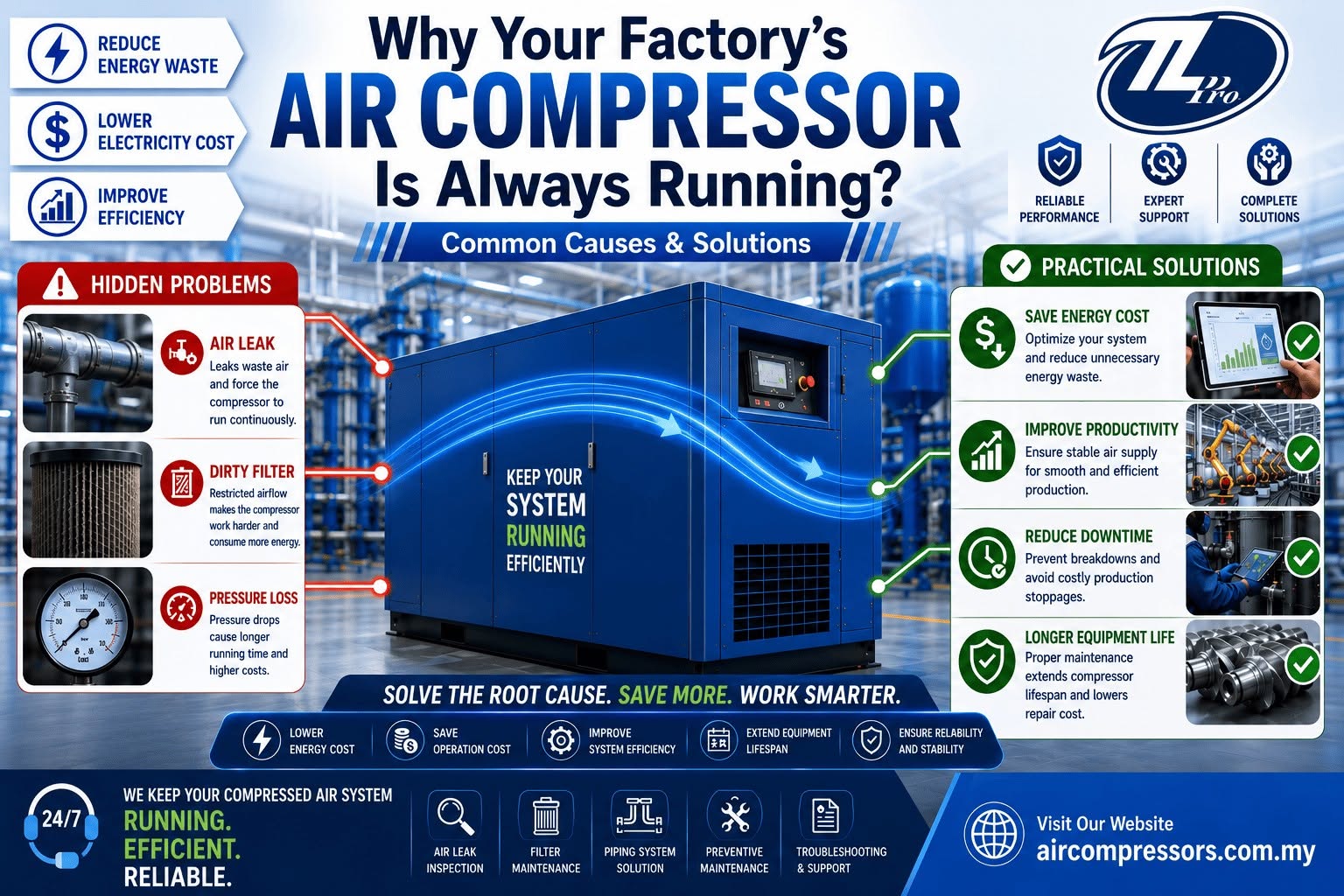
Have you noticed your air compressor running almost all the time?
Many factories assume this is normal, especially during busy production periods. However, if your air compressor keeps running continuously, it may indicate hidden issues inside your compressed air system.
Ignoring the problem can increase electricity costs, reduce efficiency, and shorten equipment lifespan.
In this article, we will look at the common causes and practical solutions.
Why Is Your Air Compressor Always Running?
An air compressor should not constantly run at full load for long periods unless production demand is very high.
If the compressor runs continuously, it often means the system is working harder than necessary.
This can lead to:
 Higher electricity costs
Increased wear and tear
Reduced compressor lifespan
Unexpected downtime
Lower system efficiency
1. Air Leakage in the Compressed Air System
Air leakage is one of the most common reasons compressors keep running.
Even a small leak can waste a large amount of compressed air over time. The compressor then works harder to replace the lost air.
Common signs:
- Hissing sounds near pipes or fittings
- Compressor loading frequently
- Pressure dropping quickly
- Higher electricity bills
Solution:
Carry out regular air leakage inspections and repair leaks as early as possible.
2. Pressure Settings Are Too High
Some factories increase pressure settings thinking it will improve performance.
In reality, setting the pressure too high often increases energy consumption without improving production.
Higher pressure forces the compressor to run longer and work harder.
Solution:
Review and adjust pressure settings according to actual production requirements.
3. Dirty or Blocked Filters
Air filters help protect the compressed air system from dust and contaminants.
Over time, filters become dirty and restrict airflow.
Restricted airflow can make the compressor run continuously to maintain pressure.
Common signs:
- Reduced airflow
- Pressure loss
- Higher operating temperature
Solution:
Inspect and replace filters according to the maintenance schedule.
4. Piping System Problems
The piping system plays an important role in compressed air performance.
Poor piping design can create pressure losses.
Examples include:
- Pipes that are too small
- Too many bends
- Long pipe routes
- Aging pipes
Solution:
Review the compressed air piping layout and ensure proper sizing.
5. Incorrect Compressor Sizing
A compressor that is too small for production demand may run continuously.
On the other hand, an oversized compressor may also waste energy through inefficient operation.
Solution:
Select a compressor based on actual air demand and future production requirements.
How To Reduce Compressor Energy Waste
Simple steps can help improve system performance:
✅ Inspect air leaks regularly
✅ Replace filters on time
✅ Check pressure settings
✅ Review piping systems
✅ Carry out preventive maintenance
✅ Monitor compressor performance
Regular inspections can help identify problems before they become costly.
Final Thoughts
If your air compressor is always running, do not assume it is normal.
Small hidden problems can slowly increase operating costs and reduce system efficiency.
Finding the root cause early can help improve productivity, reduce energy waste, and avoid unnecessary downtime.
TL Pro Industrial Supplies Sdn. Bhd. provides complete industrial air solutions including air compressors, piping systems, air dryers, maintenance services, and troubleshooting support.